Overview
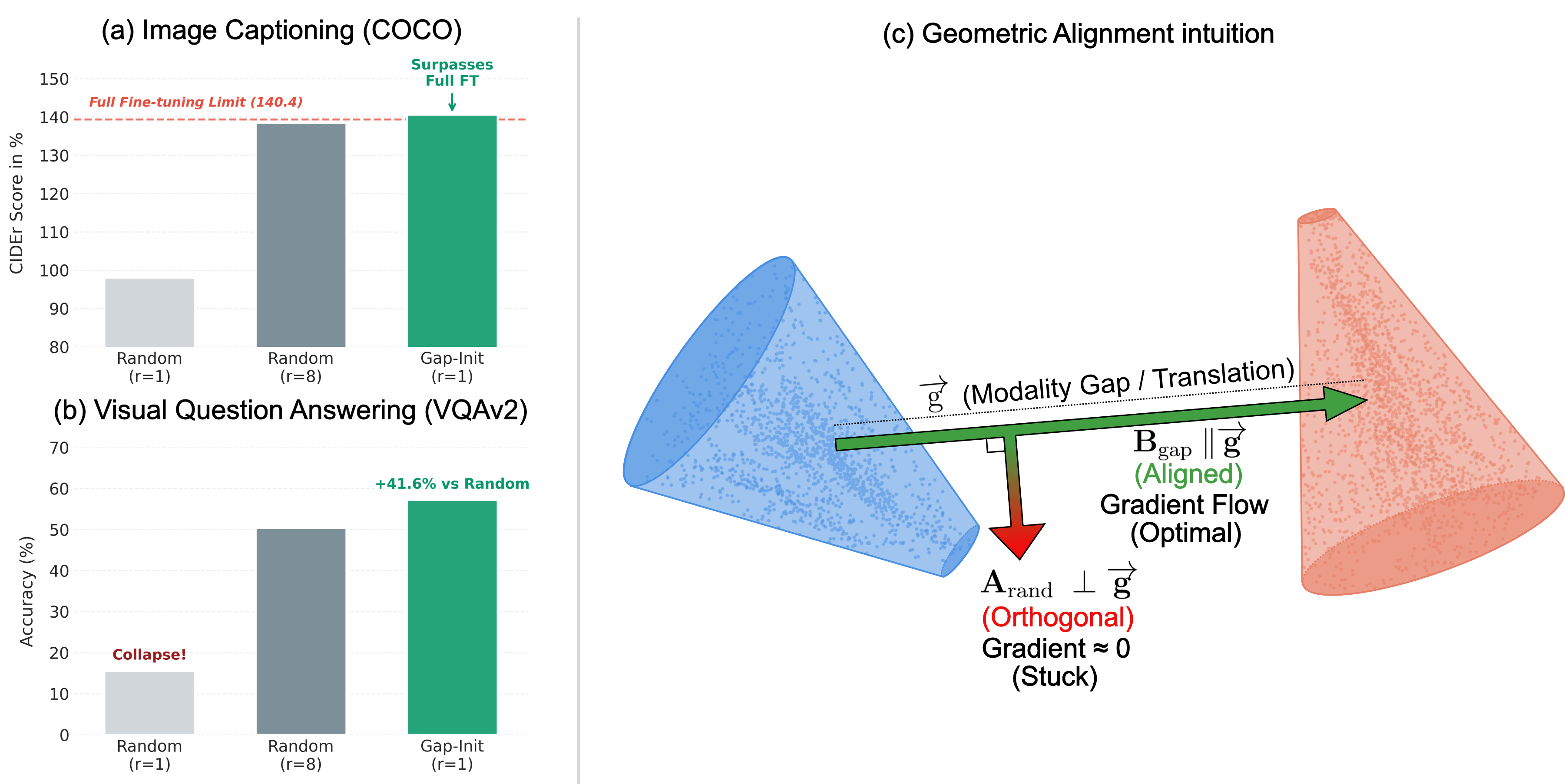
Gap-Init is a geometry-aware initialization strategy that enables stable and effective rank-1 LoRA adaptation for multimodal large language models. It estimates a modality-gap vector from a small calibration set, aligns the LoRA update direction with this geometry-salient axis, and preserves the pretrained model behavior at initialization.
Method
Random rank-1 LoRA directions are almost surely orthogonal to the modality-gap axis in high-dimensional spaces. Gap-Init uses this geometry to choose an update direction that receives meaningful gradient signal from the start.
Identify the modality gap
Estimate the translation-like mismatch between vision and text representations from a small calibration set.
Align rank-1 LoRA
Set the LoRA B matrix to the normalized gap direction while keeping A at zero.
Restore gradient flow
The update direction now projects onto the geometry-salient axis instead of collapsing into near-orthogonality.
Input:  Pretrained MLLM, calibration set D_cal, LoRA rank r
Output: Initialized LoRA matrices (B, A)

1. Extract aligned embeddings:
   z_v = projection(vision_encoder(x_img))
   z_t = text_encoder(x_txt)
   g_i = z_t - z_v

2. Estimate layer-wise gaps:
   g_l = mean(smooth(g_i))

3. Initialize LoRA:
   B[:, 0] = g / ||g||
   A = 0

Return (B, A)
Results
Gap-Init turns rank-1 LoRA from an unstable low-rank bottleneck into a competitive adaptation regime.
| Configuration | CIDEr |
|---|---|
| Naive + Random Init | 98.08 |
| GG-Safe + Random Init | 102.15 |
| GG-Safe + Gap-Init | 140.06 |
| Naive + Gap-Init | 140.59 |
| Noise Level | CIDEr | BLEU-4 |
|---|---|---|
| 0.0 | 141.84 | 42.55 |
| 0.2 | 140.04 | 41.62 |
| 0.6 | 142.00 | 43.43 |
| 1.0 | 133.45 | 39.62 |
Quick Start
The codebase supports gap-vector diagnostics, Gap-Init training, and evaluation for captioning and VQA experiments.
Install
Create the project environment.
git clone https://github.com/HaoranZhao2000/Gap-Init.git
cd Gap-Init
conda env create -f environment.yml
conda activate gapinit
Extract gaps
Estimate gap vectors from a calibration set.
python run_diagnostics_master.py \
  --config configs/gap_init_rank1_naive.yaml \
  --target_module text \
  --num_samples 256
Train and evaluate
Run rank-1 Gap-Init adaptation.
python train_caption_master.py \
  --config configs/gap_init_rank1_naive.yaml \
  --seed 42

python eval_master.py \
  --model_path output/gap_init_rank1_naive_seed42 \
  --task caption
Citation
If you find this work useful, please cite the paper.
@inproceedings{zhao2026rank,
  title={When Is Rank-1 Enough? Geometry-Guided Initialization for Parameter-Efficient Fine-Tuning},
  author={Zhao, Haoran and Han, Soyeon Caren and Hovy, Eduard},
  booktitle={Forty-third International Conference on Machine Learning},
  year={2026},
  url={https://openreview.net/pdf?id=Umu6IsAUbS}
}